Tag: diagnosis

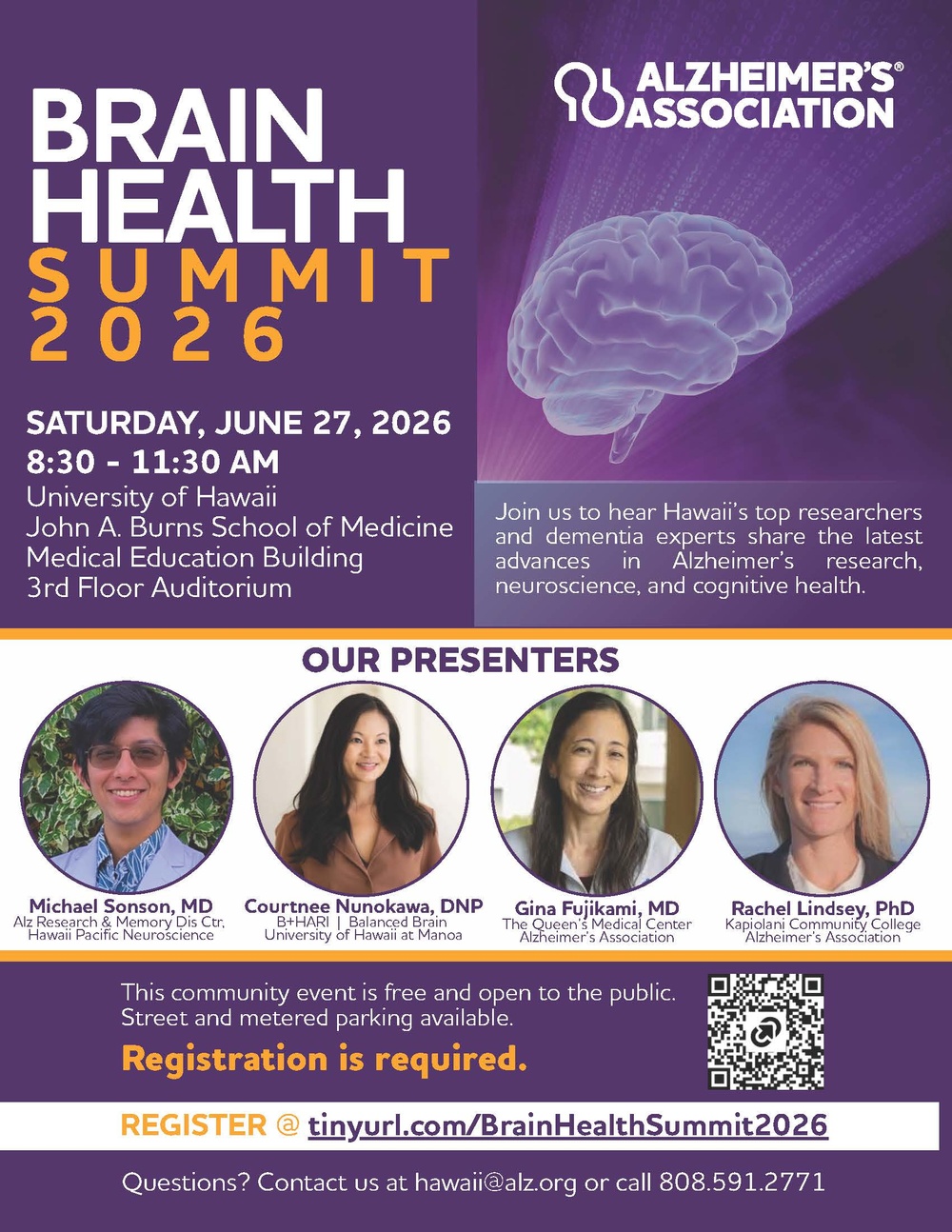
Brain Health Summit

The Alzheimer’s Association Brain Health Summit brings together Hawaii’s leading researchers and experts to share the latest research updates and breakthroughs in the understanding, diagnosis, treatment, and prevention of Alzheimer’s disease and related forms of dementia.

Join us for a dynamic morning dedicated to the latest advances in brain health and hear directly from our lineup of local experts as they share fresh insights into neuroscience and cognitive health.

This free, half-day summit will spotlight new research, emerging diagnostics and therapeutic approaches, including disease-modifying treatments available in Hawaii and key lifestyle interventions that can keep our brains healthy and reduce our risk of cognitive decline.

Connecting Health Care, Public Health, and Community for Dementia Detection and Care Copy

This inaugural forum, hosted by the Gerontological Society of America (GSA), will bring together researchers, clinicians, public health professionals, and community-based organizations to explore innovative, real-world strategies for improving brain health and dementia care.

Designed as an interactive, application-focused experience, the forum will highlight exemplar initiatives and practical solutions aligned with the KAER (Kickstart, Assess, Evaluate, Refer) framework, which supports early detection of cognitive impairment and effective care coordination across clinical and community settings.  

June 16, 2026 at 12-2 pm ET (6-8am HST) and June 17, 12-2 pm ET (6-8am HST)

Key highlights include:

  • Building practical skills to enhance early detection, diagnosis, and connection to dementia care
  • Showcasing scalable, real-world strategies from clinical and community environments
  • Encouraging cross-sector collaboration across health care, public health, and community organizations
  • Focusing on implementation, what’s working now, and how approaches can be adapted locally

Moderated by Drs. Soo Borson and Joshua Chodosh, the forum will feature a mix of faculty presentations, case studies, and peer-driven discussions, with a strong emphasis on actionable insights and shared learning. 

This event may be especially valuable for applicants seeking to strengthen their approaches to brain health, dementia detection, and cross-sector collaboration within their proposals.

Registration is discounted for GSA regular members and complimentary for GSA student members. Registration for Non-Members: $69.00

Connecting Health Care, Public Health, and Community for Dementia Detection and Care

This inaugural forum, hosted by the Gerontological Society of America (GSA), will bring together researchers, clinicians, public health professionals, and community-based organizations to explore innovative, real-world strategies for improving brain health and dementia care.

Designed as an interactive, application-focused experience, the forum will highlight exemplar initiatives and practical solutions aligned with the KAER (Kickstart, Assess, Evaluate, Refer) framework, which supports early detection of cognitive impairment and effective care coordination across clinical and community settings.  

June 16, 2026 at 12-2 pm ET (6-8am HST) and June 17, 12-2 pm ET (6-8am HST)

Key highlights include:

  • Building practical skills to enhance early detection, diagnosis, and connection to dementia care
  • Showcasing scalable, real-world strategies from clinical and community environments
  • Encouraging cross-sector collaboration across health care, public health, and community organizations
  • Focusing on implementation, what’s working now, and how approaches can be adapted locally

Moderated by Drs. Soo Borson and Joshua Chodosh, the forum will feature a mix of faculty presentations, case studies, and peer-driven discussions, with a strong emphasis on actionable insights and shared learning. 

This event may be especially valuable for applicants seeking to strengthen their approaches to brain health, dementia detection, and cross-sector collaboration within their proposals.

Registration is discounted for GSA regular members and complimentary for GSA student members. Registration for Non-Members: $69.00

Understanding and Responding to Dementia Behaviors: Caregiver Conference

This full day in-person conference (with Zoom link available) is for unpaid family and friend caregivers who are caring for someone with memory loss or dementia. This event will feature information about dementia and behavioral symptom management given by expert geriatricians — as well as insight and practical tips from an experienced dementia care trainer of Teepa Snow’s Positive Approach to Dementia Care (PAC) program. The presenters will cover:

  • Overview of dementia: causes and prevalence
  • Behavioral and Psychological Symptoms of dementia (BPSD)
  • Benefits and importance of professional assessment and accurate diagnosis for the person experiencing memory loss and for those providing care
  • Working as a team with healthcare providers for optimal quality of life
  • Managing BPSD: Geriatricians’ and Neurogistʻs Perspectives
  • Emotional and Physical needs of people living with dementia that can lead to challenging behaviors
  • Understanding and responding to behaviors as dementia progresses: practical tips for unpaid family caregivers
  • Tips and Best Practices for Communication, Safety and Environmental Adjustments

Presenters:

Dr. Kamal Masaki is Professor and Chair of the Department of Geriatric Medicine at the John A. Burns School of Medicine, University of Hawai‘i at Mānoa, which is a John A. Hartford Foundation Center of Excellence in Geriatrics (one of 25 in the U.S.). She also serves as Academic Medical Director for Geriatrics at the Queen’s University Medical Group, and Director of Research at Kuakini Medical Center. She is board certified in Internal Medicine and Geriatric Medicine. She was elected to be a Fellow of the American Geriatrics Society. She has been doing aging and dementia research for over 35 years. Dr. Masaki has received numerous teaching and research awards, and was selected by Hawaii physicians to “The Best Doctors in America” 3 times. She is a co-author on over 325 publications in scientific journals.

Dr. Abraham Chyung, MD-PhD, is an Assistant Clinical Professor of Medicine at the John A. Burns School of Medicine, University of Hawai’i. He is a board certified neurologist specializing in memory disorders at the Neuroscience Institute, Queen’s Medical Center. His professional ambition is to make Alzheimer’s disease treatment available to the Kupuna community of Hawai’i. Towards that end, he has partnered with many groups like Catholic Charities Hawai’i, Alzheimer’s Association, The Queen’s Health Systems leadership, Primary Care doctors, Geriatrics Specialists, Mental Health specialists, and caregivers. He appreciates the support of everyone who shares the vision of making accessible early detection, diagnosis, and treatment to those afflicted by Alzheimer’s disease and related dementias.

Jessica Barry, MD has been working at The Queen’s Medical Center Geriatric Services for 15 years. Born and raised in Kansas, she attended University of Kansas for undergraduate and medical school. Her Internal Medicine Residency was at Brown University in Providence, Rhode Island. Her Geriatric Fellowship was with University of Hawaii John A. Burns School of Medicine. She aims to keep her older patients independent as long as possible while maintaining an optimal quality of life with proactive prevention, early diagnosis, and targeted treatment. She and her husband from Hawaii have two children. She is passionate about dementia education for lay persons and health professionals. In her free time, she ferries the children to their activities and squeezes in running and reading novels.

Dorothy Colby is a Certified Positive Approach to Care™ (PAC)Trainer and national Mentor, with more than 25 years of professional and personal experience caring for people with dementia and training caregivers. The PAC trainings created by Teepa Snow share dementia care techniques that provide essential information for unpaid and professional caregivers on how to have a positive and meaningful relationship with loved ones living with all forms of dementia. Dorothy is Director of Community Engagement for Hale Kuʻike Memory Care Homes at Nuʻuanu, Bayside & Pali locations.

For those who wish to attend in person, lunch and printed handouts will be provided. Parking charges will be $5 per vehicle with conference center validation.
Please NOTE: In-person attendance is limited. We will prioritize unpaid family and friend caregivers of someone living with dementia.

Parking instructions and directions will be sent to registrants who plan to attend in person. Printed handouts of the slides will be provided that morning.
All registrants will receive a link to a digital copy of the slides and program agenda, prior to June 10.

This free training is sponsored by Catholic Charities Hawaii, and supported, in part by Alzheimer’s Disease Programs Initiative grant number 90ADPI0108-01-00, from the U.S. Administration for Community Living, DHHS, Washington, D.C. 20201.

Sorry, there are no CEs or Certificates available for this presentation.
Supporting Function and Safety After Diagnosis: Dementia Care Planning for Adults with IDD

The National Task Group on Intellectual Disabilities and Dementia Practices is hosting an educational series called “Advancing Dementia-Capable Primary Care: Supporting Adults with Intellectual Disabilities.” This series supports primary care clinicians participating in the CMS GUIDE Model and others serving adults with IDD, including Down syndrome. The series provides a practical, step-by-step framework spanning early identification, diagnostic evaluation, medical management, and post-diagnosis care planning.

1 Free CME contact credit will be provided upon attendance and completion of post webinar survey.

Following a dementia diagnosis, adults with intellectual and developmental disabilities (IDD) need coordinated, person-centered support. Presented from a nurse practitioner and social work perspective, this one-hour webinar focuses on practical post-diagnosis care planning, highlighting strategies to support function, safety, communication, and collaboration with families, direct support professionals, and community resources.

Presenters: Marie Clouqueur, LICSW and Kathryn Service, RN, M.S., FNP-BC, CDDN

Diagnosis and Management of Dementia in Adults with IDD

The National Task Group on Intellectual Disabilities and Dementia Practices is hosting an educational series called “Advancing Dementia-Capable Primary Care: Supporting Adults with Intellectual Disabilities.” This series supports primary care clinicians participating in the CMS GUIDE Model and others serving adults with IDD, including Down syndrome. The series provides a practical, step-by-step framework spanning early identification, diagnostic evaluation, medical management, and post-diagnosis care planning.

1 Free CME contact credit will be provided upon attendance and completion of post webinar survey.

This session will be on “Diagnosis and Management of Dementia in Adults with IDD.” Diagnosing dementia in adults with intellectual and developmental disabilities (IDD) presents unique clinical challenges that can lead to under-recognition or delayed diagnosis. This one-hour educational activity equips primary care clinicians with a structured, IDD-informed diagnostic approach, including how to adapt standard dementia evaluations, identify reversible conditions that mimic dementia, and assess likely dementia etiology. Participants will gain practical guidance on avoiding common diagnostic pitfalls and determining when specialty referral is indicated.

Presenter: Seth Keller, MD. Neurology Associates of South Jersey

Follow Us on Social Media

Sign Up for Our Email Newsletter

Receive News, Alerts & Updates via Email

You are now leaving the Hawaii Dementia Initiative website to visit an external site.