Tag: dementia

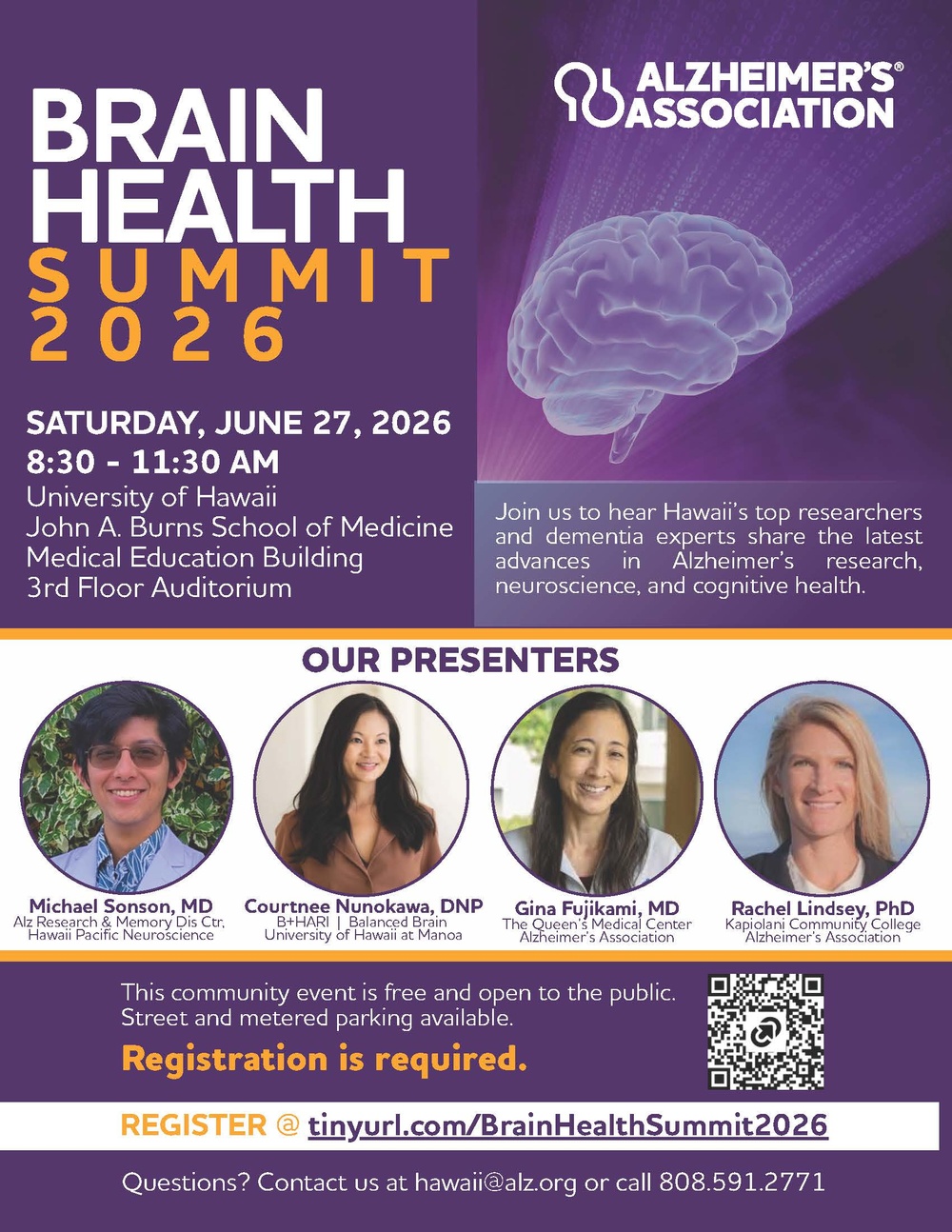
Brain Health Summit

The Alzheimer’s Association Brain Health Summit brings together Hawaii’s leading researchers and experts to share the latest research updates and breakthroughs in the understanding, diagnosis, treatment, and prevention of Alzheimer’s disease and related forms of dementia.

Join us for a dynamic morning dedicated to the latest advances in brain health and hear directly from our lineup of local experts as they share fresh insights into neuroscience and cognitive health.

This free, half-day summit will spotlight new research, emerging diagnostics and therapeutic approaches, including disease-modifying treatments available in Hawaii and key lifestyle interventions that can keep our brains healthy and reduce our risk of cognitive decline.

Dementia, Restraints, and the Regs

Healthcare Association of Hawaii is hosting this webinar. Providing care to those living with dementia in nursing facility settings can be complex and rewarding. Having an understanding of various approaches to deal with challenging behaviors is important and impactful to the resident’s quality of life.

Best practice standards indicate that dementia behaviors should be managed without the use of physical or chemical restraints; however, when they are deemed necessary staff members must have knowledge of current CMS regulations and documentation requirements. The interdisciplinary team must make efforts to reduce psychotropic drug use as appropriate and provide compassionate and person-centered care in compliance with regulatory standards.

Join us as we examine strategies to manage challenging behaviors from those living with dementia and discuss physical and chemical restraints, documentation standards, interdisciplinary approaches, and maintaining quality of life in accordance with regulatory compliance.

Learning Objectives

1. Define and describe consequences of physical and chemical restraints
2. Identify strategies to mitigate physical restraint use
3. Describe CMS regulatory requirements related to psychotropic drug use
4. Explore how to apply practice strategies to facilitate the reduction of psychotropic drug use

Target Audience

Interdisciplinary team members working in post-acute and long-term care settings

Speaker: Aida Wen, MD, CMD, Geriatrician and Associate Professor, University of Hawaii at Manoa, John A. Burns School of Medicine

Driving and Dementia: Balancing Safety, Independence, and Dignity

Hawaii experts share insights on issues related to Driving for persons who are living with memory loss or dementia and their caregivers.

By the end of the presentation, family and friend caregivers will be able to:

  • Understand how dementia can affect driving ability (Identify common cognitive, visual, and motor changes that impact driving safety at different stages of dementia)
  • Recognize warning signs and risks related to unsafe driving (Describe behaviors and incidents that may indicate it is no longer safe for a person with dementia to drive)
  • Balance safety concerns with respect for independence and dignity (Explain why driving is closely tied to identity and autonomy, and why compassionate decision-making is essential)
  • Communicate effectively about driving concerns (Apply practical strategies for initiating and navigating difficult conversations about driving with empathy and respect)
  • Feel more confident and supported as a caregiver (Identify resources and next steps to reduce stress and support both the caregiver and the person living with dementia through driving transitions)

Gina Fujikami, MD, is Division Chief of Geriatrics at The Queen’s Medical Center. She earned her MD from the University of Hawaii (UH) John A. Burns School of Medicine (JABSOM) and completed a Geriatric Medicine fellowship at the University of California, San Francisco. Dr. Fujikami is also a Clinical Assistant Professor of Geriatric Medicine at JABSOM and serves as a member of the Alzheimer’s Association Hawaii’s Leadership Board, where she chairs the Care & Support Committee. Her passion for geriatrics is personal, stemming from her experience watching her grandfather who was living with dementia, which drives her commitment to helping families navigate this diagnosis.

Ivy K. Castellanos is Director of Programs with the Alzheimer’s Association, Hawaii Chapter. She holds a Master’s degree in Behavioral Science and Health Education from the Johns Hopkins Bloomberg School of Public Health and has more than 20 years’ experience in the combined areas of health education, health promotion and disease prevention, health equity, and corporate wellness. She has served in roles with organizations such as HMSA, the American Heart Association, and HealthAssist, and has held research positions with the Johns Hopkins Center for Cancer Pain Research and the Welch Center for Prevention, Epidemiology, and Clinical Research in Baltimore, Maryland. Ivy joined the Alzheimer’s Association in 2014 and finds joy in empowering families affected by dementia. She is a full-time mom of two and a full-time caregiver for her mother.

Catholic Charities Hawaii (CCH) is continuing their series of expert speaker workshops focussing on Dementia-Related Behaviors and issues that can be challenging for caregivers and providers of persons living with dementia in the community. This series is made possible by a grant given to Catholic Charities Hawaii from the Administration for Community Living/Administration on Aging for the Alzheimer’s Disease Programs Initiative awarded to organizations across the country to increase resources and information with the goal of improving the well-being of persons living with dementia in the community and their caregivers. One of our grant objectives is offer training and support, connection to resources, and a chance to ask questions with experts in the Zoom sessions.

Supporting Function and Safety After Diagnosis: Dementia Care Planning for Adults with IDD

The National Task Group on Intellectual Disabilities and Dementia Practices is hosting an educational series called “Advancing Dementia-Capable Primary Care: Supporting Adults with Intellectual Disabilities.” This series supports primary care clinicians participating in the CMS GUIDE Model and others serving adults with IDD, including Down syndrome. The series provides a practical, step-by-step framework spanning early identification, diagnostic evaluation, medical management, and post-diagnosis care planning.

1 Free CME contact credit will be provided upon attendance and completion of post webinar survey.

Following a dementia diagnosis, adults with intellectual and developmental disabilities (IDD) need coordinated, person-centered support. Presented from a nurse practitioner and social work perspective, this one-hour webinar focuses on practical post-diagnosis care planning, highlighting strategies to support function, safety, communication, and collaboration with families, direct support professionals, and community resources.

Presenters: Marie Clouqueur, LICSW and Kathryn Service, RN, M.S., FNP-BC, CDDN

Diagnosis and Management of Dementia in Adults with IDD

The National Task Group on Intellectual Disabilities and Dementia Practices is hosting an educational series called “Advancing Dementia-Capable Primary Care: Supporting Adults with Intellectual Disabilities.” This series supports primary care clinicians participating in the CMS GUIDE Model and others serving adults with IDD, including Down syndrome. The series provides a practical, step-by-step framework spanning early identification, diagnostic evaluation, medical management, and post-diagnosis care planning.

1 Free CME contact credit will be provided upon attendance and completion of post webinar survey.

This session will be on “Diagnosis and Management of Dementia in Adults with IDD.” Diagnosing dementia in adults with intellectual and developmental disabilities (IDD) presents unique clinical challenges that can lead to under-recognition or delayed diagnosis. This one-hour educational activity equips primary care clinicians with a structured, IDD-informed diagnostic approach, including how to adapt standard dementia evaluations, identify reversible conditions that mimic dementia, and assess likely dementia etiology. Participants will gain practical guidance on avoiding common diagnostic pitfalls and determining when specialty referral is indicated.

Presenter: Seth Keller, MD. Neurology Associates of South Jersey

Can Do! Reframing Dementia Support and Education to Focus on Strengths and Resilience

Living well with dementia is deeply influenced by the mindsets of both people living with dementia and their caregivers. Learning to Live with Dementia is a new support and education program model that combines a structured series of brief lessons with facilitated group sessions designed for people living with dementia and for caregivers to reflect on and share their experiences.

This innovative approach promotes a shift in perspective—focusing on what people can do to live well with dementia and providing practical strategies to support that goal. In this webinar, participants will learn about this strengths-based support and education program, hear inspirational stories, and gain new perspectives designed to reframe both the dementia journey and the caregiving experience.

Participants will also be introduced to the Learning to Live with Dementia Facilitator Toolkit, a resource developed to strengthen facilitator skills, confidence, and capacity to deliver structured, group-based education and engagement.

Direct questions to NADRC-Webinars@rti.org

Please note:

NADRC webinars are free and open to the public.

NADRC webinars are recorded and will be posted at https://nadrc.acl.gov/.

Closed captioning is available during the webinar and included in all recordings

Early Detection of Dementia: What to Do Now — National Resources to Plan, Partner, and Act

The BOLD Public Health Center of Excellence on Early Detection of Dementia is pleased to offer an upcoming webinar to discuss new resources that they have developed for our partners, including two new resource guides — one for community-based organizations and one for health departments who are interested in promoting early detection of dementia within and across sectors.

In this conversation they will discuss how to leverage the Center’s resources to assess needs and assets; identify goals and next steps; build and sustain partnerships; and measure and communicate your impact.

Meeting Communities Where They Are: Innovative Approaches to Dementia Supports and Services

Addressing the unique support and service needs of communities is central to effective home- and community-based dementia care. While many dementia-specific interventions are grounded in research and best practices, they often require thoughtful adaptation to effectively reach underserved populations. Supports and services for people living with dementia, their caregivers, and their communities are most impactful when tailored to reflect cultural values, language, and lived experiences.

This webinar will feature two specialized, community-based dementia programs, each focused on an underserved population—African American and Korean American communities. Both programs have adapted their approaches to reduce barriers to service acceptance, increase engagement, and address unmet needs. Together, they will demonstrate strategies for delivering strengths-based, dementia-specific services and supports while navigating and overcoming challenges.

Direct questions to NADRC-Webinars@rti.org

Please note:
NADRC webinars are free and open to the public.
NADRC webinars are recorded and will be posted at https://nadrc.acl.gov/.
Closed captioning is available during the webinar and included in all recordings.

Safety First: Understanding and Responding to Dementia Behaviors

Catholic Charities Hawaii (CCH) is offering another Zoom workshop focusing on Dementia-Related Behaviors that can be challenging for caregivers and providers of persons living with dementia in the community. This session will target unpaid caregivers of persons living with dementia in the community and the service providers, friends & family, neighbors, educators, and advocates who support them. These workshops are made possible by a grant given to Catholic Charities Hawaii from the U.S. Administration for Community Living/DHHS for the Alzheimer’s Disease Programs Initiative awarded to organizations across the country to increase resources and information to improve the well-being of persons living with dementia in the community and their caregivers. 

The workshop will cover:

    • Benefits of working as a team with healthcare and community resources through all stages of dementia
    • Behavioral and Psychological Symptoms of dementia and why safety comes first
    • What the caregiver can do to help increase safety at home for their person living with dementia
    • Fall prevention and dementia, assessing and modifying the environment
    • Wandering issues: tips for environmental changes, safety in and out of the home
    • Dining and Safety: being prepared for possible swallowing difficulties and nutrition/hydration challenges
    • Alzheimer’s Association, Hawaii Chapter statewide resources, programs and education 

Expert Panel Presenters:

Jessica Barry, MD has been working at The Queen’s Medical Center Geriatric Services for 15 years. Born and raised in Kansas, she attended University of Kansas for undergraduate and medical school. Her Internal Medicine Residency was at Brown University in Providence, Rhode Island. Her Geriatric Fellowship was with University of Hawaii John A. Burns School of Medicine. She aims to keep her older patients independent as long as possible while maintaining an optimal quality of life with proactive prevention, early diagnosis, and targeted treatment. She and her husband from Hawaii have two children. She is passionate about dementia education for lay persons and health professionals. In her free time, she ferries the children to their activities and squeezes in running and reading novels.

Ivy K. Castallanos is the Director of Programs with the Alzheimer’s Association, Hawaii Chapter. She holds a Master’s degree in Behavioral Science and Health Education from the Johns Hopkins Bloomberg School of Public Health and has more than 20 years’ experience in the combined areas of health education, health promotion and disease prevention, health equity, and corporate wellness. She has served in roles with organizations such as HMSA, the American Heart Association, and HealthAssist, and has held research positions with the Johns Hopkins Center for Cancer Pain Research and the Welch Center for Prevention, Epidemiology, and Clinical Research in Baltimore, Maryland. Ivy joined the Alzheimer’s Association in 2014 and finds joy in empowering families affected by dementia. She is a full-time mom of two and a full-time caregiver for her mother.

Follow Us on Social Media

Sign Up for Our Email Newsletter

Receive News, Alerts & Updates via Email

You are now leaving the Hawaii Dementia Initiative website to visit an external site.