

Dementia Data Dashboard
Let’s learn about dementia and caregivers in Hawaiʻi! How many people in Hawaiʻi are living with Alzheimer’s disease? Who are the caregivers? What dementia risk factors are most prevalent in Hawaiʻi? This page features a data tracker, resources, and links to additional relevant data sources. Our hope is that with increased data availability, we will increase data-informed decision making and advocacy for the people of Hawaiʻi.
Prevalence of Risk Factors in Hawaiʻi

37.5%
Midlife Hypertension
(age 45 – 64)

45.1%
Physical Inactivity

41.2%
Midlife Obesity
(age 45 – 64)
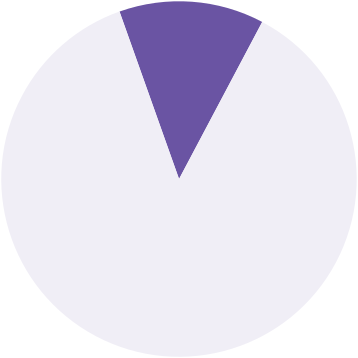
9.5%
Diabetes
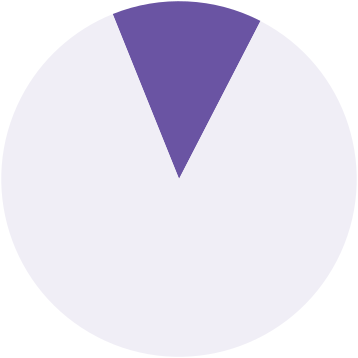
9.9%
Smoking
(age 45 and older)
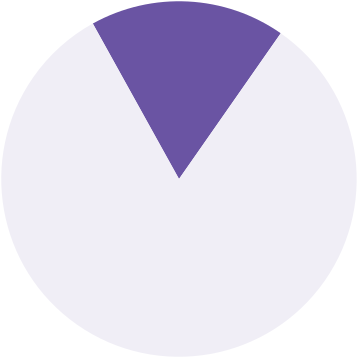
13.5%
Poor Sleep
(<6 hours/night)

Medicare Data – Dementia Prevalence & Service Utilization
The interactive graphs below use Medicare data to illustrate the prevalence of dementia and compare healthcare service utilization between individuals living with dementia and those without.
This data was generously provided by UH TASI for the Hawai‘i 2035: State Strategic Plan on Alzheimer’s Disease and Related Dementias.
Mahalo to Brave New Media LA for creating the interactive visualizations.
? Tip: Hover over the graphs to explore specific data points. Scroll sideways to view additional data in the tables below.
Learn More About TASIADRD Prevalence (%) by Age Group and Gender
In an analysis of Hawai’i’s Medicare population from 2010 to 2019, about 14% of beneficiaries were diagnosed with Alzheimer’s Disease and Related Dementias (ADRD). Prevalence of ADRD is generally higher among female beneficiaries compared to male beneficiaries, increasing as the population ages. Figure 4 indicates that ADRD prevalence tended to increase with age and was higher in older female beneficiaries. Among the 85+ population, 41% of females and 31% of males have ADRD
Technical Notes and Comments
- Analysis conducted by UH TASI in Sept 2023
- Dataset includes Hawai’i Medicare beneficiaries (n = 136,008) and fee-for-service claims from years 2010-2019
- Diagnosis flags based on FFS claims, Medicare Advantage is not included
- Diagnosis identification based on 3-year look-back period; only beneficiaries with sufficient FFS coverage included
- Prevalence does not include undiagnosed or non-Medicare residents
- Cost includes payments made by Medicare, beneficiaries, and other primary payers (as recorded by CMS); adjusted to 2019 dollars
- Cost and utilization are based on all services received, not specifically ADRD-related services
- Medicare does not cover long-term care, so the costs of care related to ADRD are likely understated.
Utilization by Diagnosis Status and Year
Beneficiaries with ADRD experienced 4.3 times as many inpatient stays as beneficiaries without ADRD. They also experienced 2.7 times as many ER visits and 2.0 times the amount of outpatient (including home health) visits. The chart shows that Medicare service utilization is substantially higher among the ADRD population.
ER Visits (per 1000)
Inpatient Stays (per 1000)
Outpatient Stays (per 1000)
Covered Days by Diagnosis Status and Year
In addition to accounting for more stays, beneficiaries with ADRD experienced longer lengths of stay (covered by Medicare), approximately 8.8 times longer than beneficiaries without ADRD. The chart shows that the average Medicare covered days were substantially longer among the ADRD population.
Average Cost per Medicare Beneficiary
On average, Medicare costs were more than $12,000 higher in the ADRD population compared to the non-ADRD population. The cost differential between these two groups also increased from 2010 to 2019. The chart indicates that Medicare costs per beneficiary are generally higher among the ADRD population.
Average Cost per Medicare Beneficiary by Diagnosis Status and Year
Cost Difference per Medicare Beneficiary by Diagnosis Status and Year

More Information from Alzheimer's Association:
Click the links below to view more information about Alzheimer’s Disease in Hawaii
Sign Up for Our Email Newsletter
Receive News, Alerts & Updates via Email
Follow Us on Social Media